PRODUCT
 SPECIAL DEALS
 CATALOGUE AND STUDIOS
 QUOTES
 ELINA PILATES
 Blog
Blog HELP
HELP CONTACT
Pilates Reformer Workouts: Strengthen, Tone, and Balance Your Body
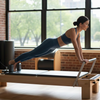
The Pilates Reformer is much more than a piece of exercise equipment—it's an extension of your body that allows you to develop strength, control, alignment, and flexibility with precision and flow. Each movement activates deep stabilising muscles, improves posture, and builds a more balanced, body-aware physique.
In this guide, we cover how to train effectively with a Reformer, the key benefits you can expect, and share guided video routines suitable for beginners through to experienced practitioners.
Why Train with a Pilates Reformer?
The Reformer is the most versatile piece of equipment in the Pilates method. Its system of springs, pulleys, and sliding carriage allows you to adjust resistance and work your entire body with accuracy and control.
Key Benefits of Reformer Training
Core strength and postural stability — Nearly every Reformer exercise requires you to stabilise through your centre, building deep abdominal strength that supports your spine throughout daily life.
Increased joint mobility and flexibility — The spring resistance allows you to move through full ranges of motion safely, improving flexibility while building strength at the same time.
Better coordination and mind-body connection — Reformer work demands concentration and precise movement, developing the neural pathways that connect intention to action.
Safe and effective for all ages and fitness levels — The adjustable resistance makes Reformer training accessible whether you're rehabilitating an injury, new to exercise, or an elite athlete.
Muscle tone without bulk or impact — The resistance-based movements build lean, functional strength without the joint stress of high-impact training or the muscle bulk of heavy weight lifting.
Reformer workouts suit both studio practice and home training, particularly with compact models from Elina Pilates designed for home and professional use.
Heavy Arms and Obliques Workout (Yellow Spring)
This focused upper body and core session targets the arms and obliques using light spring tension on the Reformer Elite. Yellow springs provide less resistance, which might sound easier—but lighter tension actually demands more muscular control and stabilisation throughout each movement.
What This Workout Covers
Arm-focused sequences — Pulling and pressing movements that challenge the shoulders, biceps, and triceps while maintaining core engagement.
Oblique work — Rotational and side-bending exercises that target the internal and external obliques, building the lateral core strength essential for spinal stability.
Upper body toning — Controlled movements that build lean muscle definition without bulk.
Why yellow springs? Lighter resistance requires you to control the carriage through muscle engagement alone, rather than relying on heavy springs to slow the movement. This builds deep stabiliser strength and improves the mind-muscle connection that defines quality Pilates practice.
Core and Stability Workout on the Lignum Reformer
This session focuses on building a strong, stable centre using the classic Wooden Lignum Reformer. Core stability forms the foundation of all Pilates movement—without it, the limbs cannot work efficiently and the spine lacks protection during everyday activities.
Who This Workout Suits
All experience levels — Core and stability work benefits everyone, from beginners establishing foundational strength to advanced practitioners refining their control.
Those seeking better posture — A stable core directly supports spinal alignment and reduces the postural fatigue that comes from desk work and daily life.
Pilates instructors — Looking for centring sequences to incorporate into client sessions.
Training Objectives
Deep core activation — Exercises that challenge the transverse abdominis and pelvic floor muscles responsible for true core stability.
Spinal articulation — Controlled flexion and extension movements that improve segmental mobility while maintaining stability.
Centre-focused strength — Building the powerhouse that supports all other Pilates work and daily movement.
Targeted Training: Glutes and Legs on the Reformer
If your goal is to tone and strengthen the lower body, short focused Reformer sessions can deliver excellent results. With just 15–20 minutes of dedicated work, you'll feel deep activation through the glutes, abductors, and hamstrings.
The Reformer is particularly effective for lower body training because the spring resistance challenges muscles through their full range of motion—something that's difficult to achieve with free weights alone.
Getting the Most from Lower Body Work
Control your speed — Moving slowly increases time under tension, which drives muscle adaptation and strength gains.
Maintain pelvic stability — Keep your pelvis neutral and avoid rocking or tilting during single-leg exercises. This protects your lower back and ensures the target muscles do the work.
Vary your foot positions — Parallel, turned out, and turned in foot positions all recruit slightly different muscle fibres, providing more complete lower body development.
Choosing the Right Reformer for Your Training
The quality of your Reformer directly affects the quality of your practice. A well-built machine with smooth carriage movement and reliable spring tension makes it easier to focus on your form rather than fighting the equipment.
For home practice, look for a Reformer that balances professional features with practical considerations like storage and footprint. The Elina Pilates Aluminium Reformers offer studio-quality performance in designs suited to Australian homes, while the Wood Reformer range brings classic aesthetics with modern functionality.
Studios and instructors benefit from equipment built for intensive daily use. Features like adjustable rope pulleys, multiple spring positions, and durable upholstery become essential when multiple clients use the same machine throughout the day.
Building Your Own Reformer Practice
Consistency matters more than duration. Three 30-minute sessions per week will deliver better results than one long session followed by weeks of inactivity.
If you're new to Reformer training, consider starting with guided sessions—either with an instructor or following video workouts like those above. Learning proper spring settings, body positioning, and movement patterns from the beginning prevents bad habits that become difficult to correct later.
As you gain experience, you can begin structuring your own workouts based on your goals. A balanced weekly programme might include one full-body session, one upper-body focused session, and one lower-body focused session, with core work integrated throughout.
Explore Pilates Reformers at Elina Pilates Australia
Whether you're setting up a home studio or equipping a professional Pilates space, the Reformer collection at Elina Pilates Australia includes options for every requirement. From compact home models to Reformers with Towers for expanded exercise variety, each machine is built with professional-grade materials and backed by comprehensive warranty coverage.
Browse the complete range and find the Reformer that matches your training goals and space.
For questions about Reformers or help selecting the right equipment for your needs, contact Elina Pilates Australia at 1300 840 718 or sales@elinapilates.com.au.